CAF Reverses Four Year AFCON Plan Over Africa Nations League Revenue Concerns
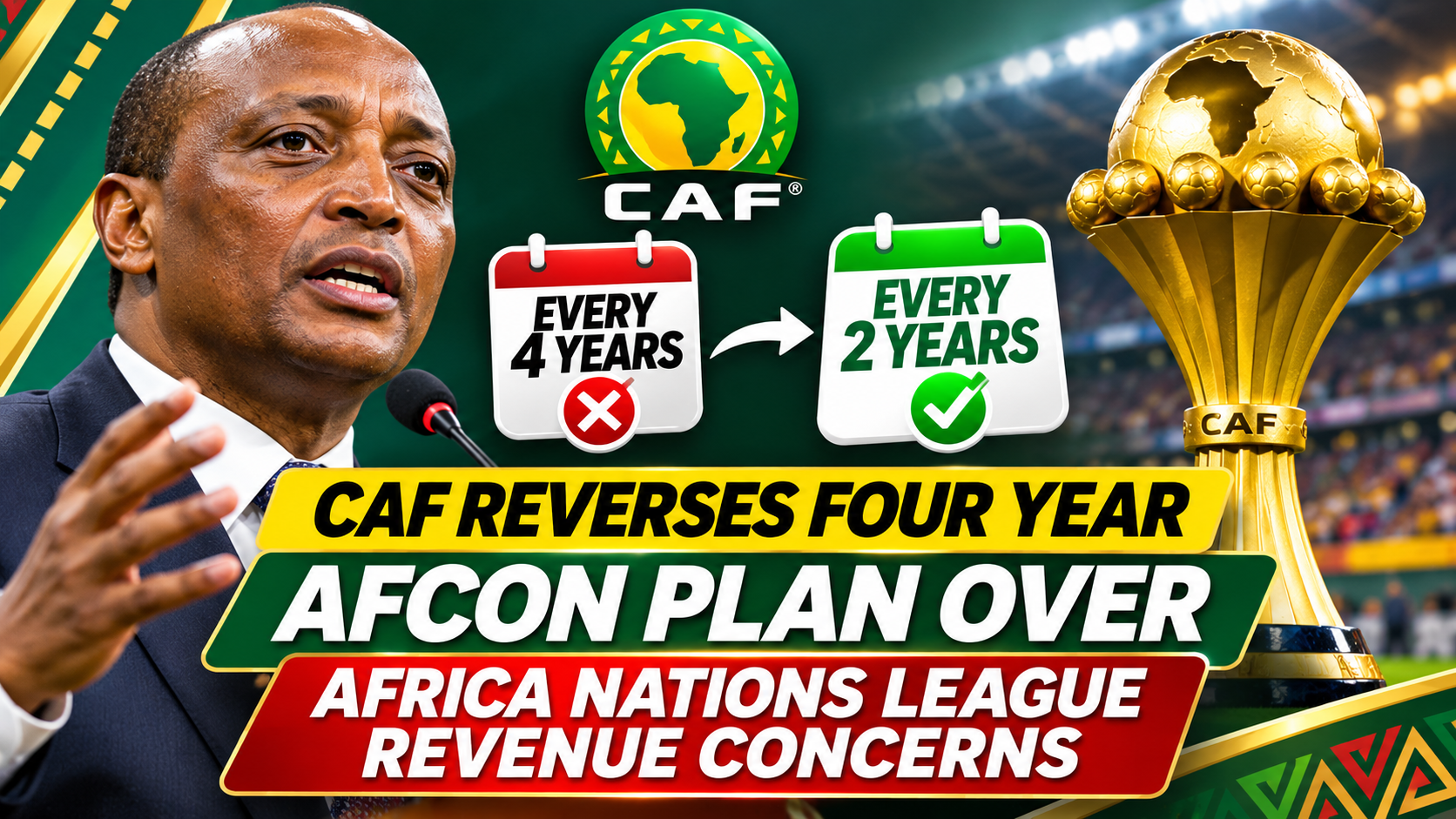
The Confederation of African Football has abandoned its controversial proposal to stage the Africa Cup of Nations every four years after reviewing the financial risks associated with its planned Africa Nations League. CAF announced on 29 October 2026 that AFCON would retain its traditional two-year cycle, reversing a decision introduced just ten months earlier. President Patrice Motsepe acknowledged that the proposed replacement competition would require several years to generate sufficient revenue. The announcement protects one of African football's most valuable tournaments while raising important questions about the governing body's financial strategy and international calendar.
CAF Officially Reverses Four Year AFCON Decision
CAF's Executive Committee unanimously approved the return to a biennial Africa Cup of Nations.
The announcement followed discussions during the organisation's strategy conference in Cabo Verde between 7 and 9 October.
Motsepe had indicated at that meeting that the governing body was reconsidering its previous decision.
The reversal preserves AFCON's established position in African football, where the tournament has traditionally taken place every two years.
Although the four-year proposal was intended to modernise the international calendar, concerns about its practical consequences eventually prompted CAF to reconsider.
Why CAF Originally Proposed Changing AFCON Schedule
The four-year proposal was introduced in December 2025 to address longstanding difficulties surrounding international football scheduling.
AFCON frequently overlaps with European domestic competitions, creating disagreements between clubs and national associations over player availability.
Moving to a four-year cycle was presented as one possible solution.
CAF also intended to introduce an Africa Nations League, providing regular international competition between major tournaments.
The proposed restructuring attracted substantial attention among supporters following Free Football Streams, African national teams and international football developments.
However, reducing AFCON's frequency raised concerns about its commercial importance and the opportunities available to African football associations.
Africa Nations League Revenue Concerns Trigger Major Reversal
The central problem was the uncertain financial future of the proposed Africa Nations League.
CAF initially hoped the new competition would provide a sustainable commercial model involving its 54 member associations.
However, officials recognised that establishing substantial broadcasting agreements, sponsorship arrangements and commercial partnerships could take several years.
That delay created a serious financial risk.
CAF depends heavily on revenue from established competitions to support its wider activities.
Reducing AFCON's frequency before developing a commercially successful replacement could have weakened that financial structure.
The governing body therefore decided against relying on projected income from a competition that had not yet demonstrated its earning potential.
AFCON Remains CAF Biggest Commercial Asset
The Africa Cup of Nations is a major source of income for African football.
The 2025 tournament in Morocco was projected to generate approximately $192 million in revenue, representing around 66 per cent of CAF's competition income.
Its projected profit was approximately $114 million, compared with $75 million for the previous edition in Ivory Coast.
These figures underline why reducing the tournament's frequency represented such a significant commercial decision.
AFCON generates income from broadcasting rights, sponsorships and other commercial arrangements.
Those resources help support CAF competitions and football development programmes.
Replacing an established revenue stream with an untested competition would have exposed the organisation to considerable uncertainty.
Patrice Motsepe Explains CAF Financial Priorities
CAF president Patrice Motsepe defended the reversal as a decision intended to protect African football's long-term interests.
He emphasised the needs of the organisation's 54 member associations and African players representing clubs outside the continent.
Motsepe acknowledged that the proposed Nations League would not immediately provide the financial contributions necessary to support CAF's ambitions.
His explanation suggests the governing body recognised a gap between its commercial objectives and the resources available to deliver them.
CAF now faces the challenge of developing new competitions without placing its most established tournament at risk.
National Football Associations Influence AFCON Decision
The original four-year proposal also attracted criticism over how the decision was made.
CAF's Executive Committee approved the change in December 2025 without first presenting it to a general assembly involving all member associations.
That approach raised questions about consultation and representation.
CAF subsequently asked its 54 associations to express their preferences regarding the tournament's future.
Several stakeholders favoured retaining the familiar two-year cycle.
For smaller football associations, regular AFCON participation provides valuable competitive experience, international exposure and financial opportunities.
The decision therefore reflects concerns extending beyond broadcasting revenue alone.
What Happens to the Africa Nations League Now
CAF has not definitively abandoned the Africa Nations League itself.
The competition was originally proposed as an annual event involving national teams across the continent.
However, the financial assessment has raised questions about its eventual structure and commercial viability.
A September 2029 launch has been proposed, but the revised format and detailed calendar still require clarification.
CAF's latest statements suggest a different competition cycle from the original annual proposal.
Organisers must explain how the Nations League would operate alongside AFCON without increasing pressure on an already congested international calendar.
Its future success will depend on viable funding, meaningful competition and clear scheduling.
Upcoming AFCON Tournaments and Confirmed Schedule
CAF has identified the next four AFCON editions as 2027, 2028, 2031 and 2033.
The 2027 tournament will take place in Kenya, Tanzania and Uganda from 19 June to 17 July.
The three countries will jointly host the competition, bringing a major international football event to East Africa.
The following edition is scheduled for 2028, although its host and exact dates have not been confirmed.
CAF has also ruled out a tournament in 2030 because of the FIFA World Cup.
Consequently, the transition will not follow a perfectly consistent two-year interval immediately, despite the decision to restore the traditional cycle.
Follow AFCON Fixtures and International Football on Totalsportek
Totalsportek provides football supporters with a way to explore upcoming matches, competition schedules and available external viewing options.
As AFCON qualification continues, fans can follow tournament developments and identify fixtures involving their preferred national teams.
The platform organises football coverage around individual match listings, helping visitors locate relevant fixtures rather than searching through unrelated sporting events.
Users can browse match information without purchasing a subscription or creating an account.
When available, external streaming links may appear alongside fixture information, allowing supporters to review potential viewing options.
However, the availability, reliability and viewing permissions of those sources depend on individual providers and regional broadcasting arrangements.
Totalsportek can also help fans follow European club fixtures involving African internationals between national-team tournaments.
With AFCON retaining its traditional frequency, supporters will continue having regular opportunities to follow Africa's leading international competition.
European Clubs Still Face AFCON Scheduling Challenges
Restoring the biennial format does not resolve disagreements involving European clubs.
Many African internationals play for teams competing in the Premier League, La Liga, Serie A and other European competitions.
When AFCON takes place during the domestic season, clubs can lose important players for several weeks.
A four-year schedule could have reduced the frequency of those disruptions.
However, CAF must balance club concerns against the interests of national teams and the financial importance of its competitions.
Future scheduling discussions will remain necessary, particularly as FIFA expands its own international tournaments.
What CAF Decision Means for African Football Future
The reversal demonstrates the difficulty of introducing major structural changes without establishing dependable commercial arrangements.
AFCON provides established revenue, international visibility and competitive opportunities for African countries.
The proposed Nations League may eventually offer additional benefits, but its financial model requires further development.
CAF must now balance commercial growth with the interests of member associations, players and supporters.
Protecting AFCON gives the governing body more time to assess those challenges.
However, questions surrounding consultation, competition funding and the international calendar remain unresolved.
Final Outlook
CAF's decision to abandon the four-year AFCON proposal represents a significant change in its football strategy.
Financial uncertainty surrounding the Africa Nations League proved central to the reversal, alongside concerns about the interests of national associations.
With tournaments scheduled for 2027, 2028, 2031 and 2033, AFCON will remain a regular feature of international football.
The challenge now is ensuring that future reforms strengthen African football without undermining its most valuable competition.